Showing posts with label AWS. Show all posts

Sunday, January 16, 2011

Google excludes scheduled maintenance from its Google Apps SLA, but not Google App Engine

Back in July of 2010, I wrote about how Cloud Service Providers exclude scheduled downtime from their service level agreements.  Last Friday, Google made a significant change to their SLA for Google Apps by removing scheduled downtime from their Google Apps SLA:
  • Exclusion of scheduled downtime from availability SLA
  • Exclusion of intermittent downtime (periods of less than 10 minutes) from availably SLA
Obviously, it is good news for Google Apps customers.  It highlights Google’s infrastructure & operational maturity (in this case, for Google Apps specifically).  

I also think the announcement is important, because it sets a higher standard for service delivery.  By raising the bar, Google also intensifies competitive pressure on service providers such as Microsoft to offer more robust Cloud services.  Ultimately, both customers & the industry should benefit from this.

However, as I discussed in my July post, for infrastructure & platform services such as Google App Engine for Business, scheduled maintenance still remains excluded in all SLAs:
It is 2011.  If we mark the beginning of Cloud Computing by the initial public release of EC2 (2006), I think enough time has passed for Cloud service providers to do a better job of managing planned outages in a non-service-disruptive way. 

--------
Sidebar - I am a regular user of AWS, GAE, Force.com… I have been using these services for more than a couple of years.  To be fair, I have never received any emails from any of the major cloud for scheduled downtime.  I have received a few from other service providers.  So, I would say that they are all doing a pretty good job operationally (a lot better than probably what most enterprises would do), and make sure the services are always up, and almost always perform well :-].  So, they just have it in the SLA agreements for legal protection & liability.   

Never-the-less, when it comes to migrating or designing enterprise solutions, depending on the application type and use-case, this can become an issue, and require both technical implementation & operations planning.

Wednesday, December 29, 2010

A quick & dirty look at web traffic trends on AWS, Azure, Force.com, GAE, and IBM Dev/Test cloud

Since the introduction of EC2 in 2005/2006, a lot has happened.  New service providers such as Google App Engine (GAE) and Force.com have emerged.  Existing hosting providers such as GoGrid & RackSpace have transformed to cloudify their service delivery model.  And, existing platform vendors such as IBM and Microsoft have raced to implement or acquire solutions to respond to this fundamental shift. 

Different types of vendors are competing for market positions.  Some are new: AbiquoNimbula, Cloud.com (formerly VMOps)…  And, some are mature: VMware, Novell/Attachmate, CA, BMC, DELL, …  [The vendor landscape is big and complex, and includes other types of vendors including systems integrators…]

As we close 2010, I thought it would be interesting to look at some usage trends of the big names in the Cloud market. 

The statistics come from Alexa.  It uses its own methods for capturing HTTP traffic, and normalizing the data.  As such, it is important to note that it does not include non-web app workload deployed on these cloud services.  In addition, it is common for enterprises to use DNS aliasing (CNAME) to map to a custom URL.  So, it is important to consider traffic to custom URLs would not be included in the following presentation.
The intent is to provide some ideas about usage and future trends, as these vendors battle it out for dominance and market share.

Please send me any comments or questions at babakh@yahoo.com.

Wish everyone a Happy New Year!

Sunday, October 17, 2010

A brief look at Oracle and its Cloud Strategy

For the last couple of years, Oracle has shown a consistent strategy to Cloud Computing.  It has made strategic acquisitions such as Virtual Iron to gain x86 virtualization management software, and has also made investments in new products such as Virtual Assembly Builder to facilitate configuration and governance of virtual environments.

Oracle has made clear that it intends to be a provider of technology to both enterprise customers and service providers.  That it does not plan to be a public cloud provider/operator like AWS or Savvis.  Instead, Oracle works with public cloud services as a distribution and delivery partner. 

[Note: See AWS/Oracle announcement of  support for Oracle middleware and apps on EC2 using Oracle VM images.]

---------

This post is a brief look at Oracle and its cloud strategy.  First, I will review Oracle business, financial, and what it brings to Cloud Computing.  Next, I will provide a 5-minute SWOT analysis of Oracle Cloud Strategy.

Oracle business

Oracle’s goal is to be the world’s most complete, open and integrated enterprise software and hardware company.  In FY2010, it booked more than $26B in revenue.  The company breaks down its revenue as follows:

  • Software
    • New software sales
    • Software license renewals & support contract
  • Hardware
    • Hardware sales
    • Hardware support & maintenance contract
  • Services
    • Consulting
    • Education
    • On Demand

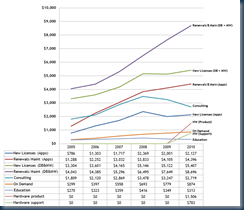
Here is their revenue trend for the last 5 years:
image

  • Oracle made over 32% of its 2010 total revenue ($26,821 million) from database & middleware renewal, and about 16% from Fusion apps renewal.  This is due to the fact that almost 90% of Oracle customers renew contracts.   [Renewal has a margin of 85%, and is the key factor to Oracle’s overall profitability.]
  • Oracle’s On Demand, which is where it offers hosted Fusion application, has also contributed to about 3% of total revenue.  This segment has shown steady growth.  In fact, since 2005, it has grown almost 3 times.  [This is a key area to future growth for Oracle especially considering all the investments they have been making to standardize Fusion apps on Fusion middleware and continue to “SaaSify” the applications.]

Oracle Cloud Business Strategy

As stated earlier, Oracle intends to be primarily a Cloud technology provider/enabler as opposed to a service operator.  This was further evidenced as it halted the rollout plans for Project Caroline after the Sun acquisition.

For enterprise customers, Oracle is addressing the needs for private cloud by providing integrated machines such as Exadata and Exalogic.  These machines help customers consolidate workloads and scale up/down as demand grows.  Oracle also continues with new products and enhancement of its middleware and enterprise management solution to enable customers build private clouds on their own hardware.

I think Oracle will be forced to change their cloud strategy for the following reasons:

  • According to analysts, about 10% of IT budget is spent on external cloud services and that percentage will keep growing (see Gartner’s survey).  Oracle needs to pay attention to this shift in enterprise IT spending, if it plans to increase marketshare and revenue.  Large customers struggle with supporting workloads in the cloud, so they look for a vendor to not only help them move workloads to the Cloud, but also provide support and management.  So, they look for hosted managed private clouds.  Oracle could address this need by leveraging Sun assets such as Caroline to offer such services.  This would position it well for future growth.   
  • It is common knowledge that Oracle wants to reach $100B in revenue in the next 10 years.  Cloud Computing, including integrated systems, is a key growth strategy for Oracle.    Oracle needs to diversify to reach that level of revenue in the next decade.  It can’t rely on acquisitions to make that happen.  Let’s assume Oracle acquires CA.  That would only boost Oracle’s revenue by $4B.  

Sidebar: Let’s play the following scenario.  Let’s assume that on average with every Exalogic Oracle charges $1M for hardware and $3M for software. Furthermore, let’s assume a %20 maintenance revenue per box / year.  If Oracle sold 1000 units every year for the next 3 years, they would book a total of $12B in combined new hardware and software + $4B in maintenance.  Everything else constant, by 2014, Oracle’s revenue would grow by $16B to $42B.  Can they do that? 

Oracle Cloud Solution

The following diagram describes Oracle’s cloud solution model:

image

Oracle models its solutions based on different Cloud service offering.   The diagram is pretty self-explanatory.  At the IaaS level, Oracle Sun hardware,  and virtualization technologies (Virtual Iron + Sun).  Oracle offers other capabilities that are not listed in this diagram such as Virtual Desktop Infrastructure (VDI) and Oracle VM Virtual Box.

In the PaaS layer, Oracle uses a combination of virtualization to isolate workloads and management deployment + grid technologies to enable dynamic resources and scaling for applications.

At the top layer, Oracle and non-Oracle apps can be deployed on this platform.  Oracle Fusion apps are optimized for Oracle Fusion middleware. 

Finally, on the right hand side, there is the management layer…The slide is a cut and paste of Richard Sarwal’s presentation at Oracle OpenWorld.  In that presentation, Richard also mentioned that there other capabilities and solution that Oracle will be offering in the next year (i.e. self-service portal, metering & charge-back, etc)

Oracle Cloud SWOT

In terms of integrated systems, Oracle will face competition primarily from IBM CloudBurst and Acadia.  On the middleware side, IBM offers a similar set of offerings based on WebSphere and Tivoli (i.e. WebSphere CloudBurst, WebSphere Virtual Enterprise, Tivoli Cloud Management stack).   Oracle will face competition from VMware vFabric.   IBM has embraced VMware as a virtualization partner (on x86)whereas Oracle decided to acquire its own virtualization.  That has been a source of friction between the two vendors.

In terms of deployment and support, IBM offers more choices than Oracle:

  • IBM & Oracle both offer enterprise-owned cloud
  • IBM offers managed private cloud services (using customers assets), but Oracle does not.  A customer would have to get a managed services contract from an Oracle partner like Wipro.
  • IBM offers IBM-hosted private cloud, but Oracle does not.  A customer would have to sign a contract with an Oracle Cloud provider like Savvis that offers both hosting and support services.
  • IBM offers a public cloud where multiple tenants share the same infrastructure. This is useful for certain workloads (i.e. email, public website) and cloud scenarios (development and testing).  Oracle doesn’t offer that.  A customer would have to find a Pay-As-You-Go provider like AWS.

So, here is a quick SWOT of Oracle Cloud:

image

Let me know what you think? 

Do you think Oracle can reach $100B in the next 10 years through an acquisition only strategy?   What other challenges do you see in Oracle’s cloud strategy, and selling its middleware machine into the enterprise?

Saturday, January 09, 2010

What apps are likely to move to the Cloud…

Earlier this week, IDC published an interesting survey on what applications are likely to move to the Cloud.   I thought about blogging about this, because they made some good points & observations in their analysis, and it also follows my previous post on application and workload analysis for Cloud Computing nicely.  
I am not going to repeat what’s said in their survey, but wanted to add a couple of points before moving any application to the Cloud:
  • Cost: What is the current annual cost of maintaining and running the existing application?   For most enterprises, cost reduction is the key driver for Cloud, so establishing the cost should probably be one of the first activities in any migration.  [N.B. If the Cloud is considered for new applications, a similar cost analysis should be performed to estimate the initial cost of building the application + estimating the annual ongoing maintenance and operation.  It would be best to breakdown the costs in terms of infrastructure, operation, and solution development & maintenance.]
  • Cloud Selection: Different Clouds offer different capabilities and different charge-back models.  As an example, with Google App Engine, you can upload your web app to Google’s infrastructure.  You’re not charged unless the application serves requests.   Now, contrast that with EC2.  Obviously, you must launch your AMI to start your application, so you’re billed for CPU usage even if the application is sitting idle. Please note that I am not suggesting GAE is better than AWS.  They are different platforms for running different types of applications, and offer different capabilities.  So, Cloud selection is a very important consideration not only with regards to costs, but also in terms of building, delivery, and management of the target solution.
There are many other considerations such as service provider’s alignment with the enterprise in terms of operations, support, compliance, SLA, and technical fit of the Cloud service vis-a-vis the application, etc…
Finally, in the overblown world of Cloud Computing where “Cloud” is myopically restricted to only a few forms such as AWS, GAE, Force.com, etc, it should be noted that many companies have already been using Internet-based services routinely for more than a decade.  These services have been used to fulfill simple functional requirements such as address normalization or tax calculation to more complex business processes (i.e. risk analysis) or business process outsourcing (i.e. order fulfillment) where enterprise data is typically hosted on an external  service provider or tightly integrated with the service provider.  So, in addition to the list of application types that IDC has presented in their survey, hosted solutions and/or BPOs represents another class of candidate applications for “Cloud Computing”.

Tuesday, November 10, 2009

Workload Analysis in Cloud Computing

Not all workloads are the same, and not all Clouds are the same!

Different applications have different set of requirements and characteristics.  Some Clouds (i.e. GAE or Heroku) are natural fits for certain class of workloads (i.e. WebApps) whereas for other types of workloads (i.e. batch), other Cloud services (i.e. AWS) are more appropriate.  In some cases, the business operation and/or legal requirements may require a completely different deployment (i.e. private Cloud). In a previous post, I referred to workload analysis in the context of approach to Cloud adoption. In this post, I thought to share some ideas about it.

The aim of Workload Analysis in Cloud Computing is to look at different aspects or characteristics of an enterprise application to determine the feasibility of moving or porting the application to the Cloud.  This analysis also provides input to implementation approach, Cloud service selection, and an initial business value assessment (i.e. cost reduction, IT simplification)…

The following proposes some guidelines in workload classification & characterization:

Workload Category: At a high-level, there are two kinds of applications in the enterprise:

  1. Custom Applications – This class of applications are developed and maintained by the enterprise.  The enterprise has control over its design, technology selection, implementation,  infrastructure requirements, maintenance, and overall portfolio roadmap. 
  2. Packaged AppsFor this class of application, the respective vendor is in control of its implementation, packaging, release, supported configurations, product plans, etc.

In the case of Custom Apps, If an enterprise is considering to deploy an application to the Cloud to achieve cost reduction or simplifying IT by delegating the infrastructure operation/maintenance to an IaaS, there is flexibility from simply taking the application pretty much as is to the Cloud –> re-factoring the application to leverage Cloud services (i.e. RDS).  In the former, the potential is substantial savings in infrastructure cost and business value in terms of new hardware & software purchase avoidance –> potential for much better SLAs and a lot more cost savings by reducing or totally eliminating the burden of additional FTEs (i.e. Database Administrators).

For Packaged Apps, the enterprise may or may not be able to move the solution to the Cloud due to licensing restrictions, technical infrastructure requirements, complex integration issues with other back-ends, etc… [it is good to check the packaged vendor for any existing or future plans for SaaS offering…]

Next, there are a set of general characteristics or attributes to consider when analyzing the applications:

  • Workload Type: In general, there are two types of workloads: Batch or Online.  It is important to consider this differentiation for the following reasons:
    • There are different resource requirements and considerations. As an example, batch workloads may require specific capacity in terms of storage and compute resources (i.e. vCPU, memory) to finish the job in a timely fashion whereas for online workloads network bandwidth may be more critical…
    • There are differences in programming models.  As an example, some batch jobs may be implemented over a framework like Hadoop whereas for some online workloads a PaaS like Force.com may be the best choice. 
  • Workload Frequency:  Sometimes, a workload may run at month-end or every quarter.  I like to note this attribute in the analysis for investment cost / benefit analysis.
  • Workload Cost: It is important to capture the total cost of workload including hardware, software, application maintenance and support, etc.  I think it would be even more useful to develop a cost allocation model reflecting percentages in infrastructure, software, application development, support and maintenance, etc…  This information is useful in Cloud service selection.
  • etc…

So, in summary, it is good practice to develop a consistent approach/process for analyzing workloads in Cloud Computing adoption.  This analysis has a range of use from business case justification to Cloud service selection. 

Also, as described in previous post, there are several sources of information to aid in workload analysis (i.e. Project Portfolio Repository, any existing server/application consolidation or decommissioning analyses, issues log or problem management database, etc). 

Finally, I highly recommend an excellent presentation that David Chou posted on his blog on patterns of moving to the Cloud

Monday, August 17, 2009

VMWare’s acquisition of SpringSource

Last week, VMWare announced that it had entered into an agreement to acquire SpringSource, an open-source enterprise Java vendor. This was a significant development, because SpringSource brings new assets and capabilities beyond virtualization to VMWare (i.e. CloudFoundry).

In VMWare’s press release, the motivation for the acquisition is described as follows: “Together, VMware and SpringSource plan to further innovate and develop integrated Platform as a Service (PaaS) solutions that can be hosted at customer datacenters or at cloud service providers.

I think the acquisition was also influenced by Red Hat’s virtualization strategy, Linux-based virtualization (KVM), its open-source approach to virtualization management (libvirt, oVirt, Thincrust…) and how it’s rallying the open source community around Cloud Computing… Also, Red Hat offers a complete middleware stack (JBoss, MRG), Systems Management solutions (Red Hat Network Satellite, JBoss Operations Network). Acquisition of SpringSource enables VMWare to compete with Red Hat and offer customers an alternative.

Who is SpringSource?

SpringSource created and leads the open source Spring framework. They offer a set of tools + consulting & support to facilitate the enterprise adoption of Spring and related open-source technologies. They are very active in other open-source projects and industry groups (Tomcat, Groovy, Grails, OSGi…)

Here are a few highlights:

Why would VMWare buy SpringSource?

SpringSource brings proven & popular technologies to VMWare that don’t overlap with their existing portfolio. It fills its technology gaps above the infrastructure & OS layers. It enables VMWare to reach new customers.

VMWare is a leader in the infrastructure virtualization space. They engage infrastructure architects and sell to data center managers. They sell from bottom up or at the C-level (i.e. cost reduction, simplification).

VMWare doesn’t speak middleware & application frameworks. Similarly, most middleware architects don’t get virtualization. First, SpringSource should be able to raise awareness about virtualization with their existing customer base (middleware architects & developers). This should open up new opportunities for VMWare fairly quickly… Next, VMWare should be able to bring SpringSource in front of their customers. That will also create new opportunities for both companies.

With CloudFoundry, VMWare is able to offer a choice to customers (private or public). By entering the market early, and early engagements with customers on both VSphere & CloudFoundry, VMWare gets a head start understanding the market requirements which enables them to plan and design more competitive Cloud solutions. That is a big advantage.

What about Red Hat?

Red Hat’s approach is different from VMWare. Their strategy is to provide an open-source virtualization solution based on Linux, and provide a unified management framework to address not just virtual infrastructure, but virtual desktops as well.

One of the advantages for Red Hat is that Linux is the most widely deployed OS in the enterprise. This is powered by their big alliance and partnership programs with mega vendors like IBM & HP. This is in balance with VMWare’s partnership program & distribution model (i.e. embedded hypervisor). However, Red Hat’s challenge remains to generalize its efforts and solutions for all Linux distributions.

Final thoughts

I think this is a market defining acquisition. It gives other Cloud Computing vendors some direction to follow. As we move forward, I think the following trends will get stronger:

  • More lightweight middleware solutions in the Cloud from open source & mega vendors (i.e. IBM, Oracle)
  • More systems management tools in the Cloud from both open source & commercial
  • More middleware & systems management appliances

A recurring question for me is what AWS’s strategy is (or should be) with regards to growth? Should they remain an infrastructure provider and incrementally build out more services (organic growth)? Should they continue to rely on partners for value-add services and distribution channel? Is it time for AWS to consider acquisition for growth? What would you do, if you were running AWS?

Sunday, February 01, 2009

Amazon’s Q4-08 report, AWS revenue, analysts, and forecasts


Despite all the catastrophic news and deteriorating economic conditions, Amazon filed another impressive Q4 earnings report last week.

For the past few months, I have been puzzled by some of the analyst estimates and predictions on Cloud Computing. For example, IDC estimates Cloud Computing market to reach $42B by 2012. According to that analysis, 2008 infrastructure as a service is valued at over $2.9B. Since Amazon is a pioneer in Cloud Computing, I decided to take a closer look at their earnings.

To understand Amazon's report, it helps to break down their business as follows:

  • Amazon Marketplace – This is Amazon's retail business where they sell their own inventory + other merchants
  • Amazon Enterprise Services (AES) – This is Amazon's consulting group that helps other retailers implement their Web channel on Amazon's sophisticated platform (i.e. Target powered by Amazon.com). There are lots of other services in this category including Fulfillment By Amazon (FBA), WebStore, etc
  • Amazon Web Services (AWS) - This is where Amazon offers a range of cloud services (infrastructure, payment, analytics, etc)

Amazon's total revenue for 2008 was over $19B with a revenue mix as follows:

  • Media – Products in this category are simple and straight forward such as books, DVDs, CDs, digital downloads, software, and video games. This was 58% of total revenue.
  • Electronics & Other General Merchandise (EGM) - More complicated products in this category from electronics & computers à shoes & jewelry à Amazon fresh (Grocery)… This was 39% of total revenue.
  • Others – AWS + AES + credit card, & advertising. This was 3% of total revenue.

For the last two years, Amazon has reported the following numbers in the Others category:

And, the total revenue for 2007 & 2008 in the US and abroad can be shown as follows:


Except for Q1 2008, Amazon has been doing quite well in Others. They have seen double digit growth for most quarters. The big question: what is the revenue contribution by AWS?

Here are some observations/assumptions to guesstimate AWS:

  • It has been quite a while since there were any announcements about a major retailer signing up with Amazon. On Amazon's website, there are only 4 customers showcased. So, AES is probably not a major growth contributor.
  • Advertising revenue could be a big factor especially as traffic and sales volume increase on Amazon.com.
  • Amazon has been reporting exponential growth in S3 objects, number of developers, # images and new partnerships (i.e. Microsoft), etc, so AWS can be major contributor.

So, if we assumed AES & credit card to make up 20% of Others, and AWS & advertising to be each around 40%, that would make Amazon's total 2008 AWS revenue around $210M. (Just based on a set of assumptions!)

Unfortunately, there is no uniform definition around Cloud Computing yet and there are many different types of vendors that offer "cloud solutions". So, analysts projections can vary greatly.

In terms of AWS and its revenue contribution to Amazon, many believe that it has the potential to exceed Amazon's retail business in not too distant of a future.

It will be interesting to see how well AWS will do and what its contribution be by 2012, especially as more enterprise vendors like IBM, MSFT, SUN, HP intensify their focus on Cloud Computing...

Thursday, December 18, 2008

AWS - An awsome example of operational excellence

I have been very lucky in my career. I have learned a lot from colleagues and mentors who have coached me or influenced my thinking. I have also had the opportunity and privilege to work with awesome customers who have challenged my approach and pushed me forward in positive ways. It has been a great journey and I think it is fair to say that I have seen a good cross-section of different organizations manage IT challenges.

As I look back at many of my projects & customer engagements, I realize that underneath all the creative project codenames and new technology buzzwords, at the heart of the issues is operational excellence. It manifests itself in terms of sustained competitiveness, new market opportunities, agility, customer-centricity… and we apply different methods or techniques to help us get there, but operational excellence fundamentally remains the main driver for all the investments.

That brings me to Amazon. It had been quite a while since my last visit to Amazon Web Services (AWS), so I thought it was time to get current with what’s changed and new.

I was delighted to see a new breed of admin interface to EC2 (http://sourceforge.net/projects/elasticfox/) and S3 (BucketExplorer, S3Fox). They make it super easy to manage Amazon Machine Images (AMIs) and files.

My Linux & Windows images booted in under 4 minutes (I picked the smallest servers) and I attached a new Elastic Block Storage (EBS) to store my application files in seconds. I was very impressed by the level of granularity and real-time usage report:

AWS exemplifies IT operational excellence in the following areas: Asset Management, Change Management, Provisioning, Service Level Management… Furthermore, they provide metrics and a level of transparency that is unprecedented.

In my 20 years of experience including 12 years of daily customer-facing roles, I haven’t seen any organization with such consistent & stable process maturity & execution.