Cloud Computing offers a great deal to the enterprise in terms of better utilization of IT assets, operational efficiency, flexibility, and lowering IT costs. Interest in Cloud Computing rose sharply since last year, as organizations in all sectors pursued cost reduction strategies to deal with the economy.
There is a lot of information on the Web about Cloud Computing from analysts, vendors, service providers, early adopters, etc… Despite a large body of information, questions still remain as to how to get started.
In this post, I am going to describe a high-level approach to enterprise adoption of Cloud Computing. In this context, Cloud Computing generically refers all types of Cloud services and instantiations (i.e. Public & Private Clouds). I won’t start with basic terms and concepts, so if you’d like some background information, please have a look at this short video from InfoWorld.
Before I begin, it is important to understand the key value proposition behind enterprise Cloud Computing. In short, the main objective is efficient IT service delivery, and effective balance of IT demand and supply. It is not just about implementing a set of technologies (i.e. virtualization, Grid). It also involves a set of principles around solution design, implementation (i.e. patterns, tools, frameworks, programming model), modification to existing IT management processes (i.e. capacity planning, configuration management, release management, change management), and governance (i.e. deployment, usage management, billing, SLA, exception management). For many organizations, adoption of Cloud Computing is simply a natural progression of existing initiatives (i.e. SOA).
So, let’s get started…
Step 0 – Cloud Computing awareness
It is hard to determine relevance or identify potential opportunities for Cloud Computing without some basic understanding of the trends and technologies. So, if you are new to Cloud Computing, I would highly recommend taking the time to learn about terms and concepts including different types of Cloud services (infrastructure-as-a-Service, Platform-as-a-Service, Software-as-a-Service), respective value proposition, usage patterns, implementation, integration, operations and management issues, risks, vendor landscape & service providers, etc.
This will help lay the foundation for further elaboration and analysis.
Step 1 – Business Value Assessment
In this step, the main idea is to establish if a business case exists for investment in Cloud Computing.
First, IT issues and challenges (aka IT hotspots) should be identified and prioritized. This can be done by reviewing key IT management practices, and analyzing operational metrics around IT service management and delivery (i.e. Demand Management, Capacity Planning, Service Level Management).
Next, the benefits of Cloud Computing should be mapped against IT hotspots (value mapping). For example, a typical IT hotspot (and a common business complaint with IT) is high cost and delay in getting any projects started and delivered. This is often due to the time and resources required to do infrastructure sizing, procurement, setup, configuration, performance testing, etc… And, the cycle repeats every time there is a new project.
A Cloud Computing approach can deliver benefits in fulfilling such IT demands rapidly and efficiently (i.e. pre-configured images based on reusable infrastructure patterns, provisioning of IT resources from external service providers.)
Finally, the benefits should be scored financially for ROI calculation and business case justification.
Step 2 – Readiness & Planning
In this step, the focus is determination of when (and where) to engage in Cloud Computing to maximize benefits.
At the end of a BVA, there should be sufficient information and analysis to develop a vision (i.e. select Cloud services –> full-blown self-service, dynamic infrastructure and on-demand business services), and reach a decision about adoption approach. There are several possibilities:
- Treat Cloud Computing as a standalone program of its own and make others comply - Personally, I wouldn’t recommend this approach, because I think organizational change management can get tough and derail adoption.
- Link Cloud Computing to existing enterprise initiatives – Such an alignment would be good, but it may delay the rollout to the enterprise.
- Blended approach – Select the right candidate projects, create a roadmap, identify gaps, and incrementally implement and roll-out towards the vision.
A blended approach would be a good way to get everyone engaged.
There are different entry points to Cloud Computing:

Readiness, gap analysis, and planning should be examined in the context and relation to other enterprise programs. This would ensure proper sequencing of related activities and timely investments to minimize impacts on the organization.
It is also necessary to understand requirements and scope for tweaking some of the existing IT management practices (i.e. Project Portfolio Management) as well as governance for codification and operationalizing the solution.
At the end, a planning and transition document should be developed that explains the approach, gaps, activities, program milestones, etc that aligns with the vision and strategy identified in BVA.
Step 3 – Cloud Computing Analysis & Modeling
In this step, we need to analyze the requirements in more detail and create a specification model for Cloud Computing.
A key objective of Cloud Computing is effective balance of IT demands and supply. So, it is appropriate to analyze and classify different types of demands, workloads, usage patterns, risks, and expected service levels:

In the diagram above, on the left we have a set of input to Cloud Computing Analysis and Modeling. In the middle, best practices & IT Governance are applied to guide and filter decisions. The result of the analysis is a set of models to describe infrastructure, workload, risk, policy, SLA, etc.
Step 4 – Cloud Computing Implementation
In the step, the analyses from the previous steps are used to make a set of decisions about implementation and technologies:
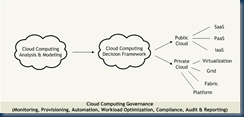
As I mentioned earlier, Governance is a key issue in Cloud Computing. There is a set of considerations around solution design and implementation as well as self-service provisioning, deployment, and SLM…
------------------------------------------
I am very curious about what customers are doing in this space and how these technologies are being used. So, if you stayed with me up to this point, I thank you first and invite you to share your experience or any comments about this post here.
Also, I am posting a short survey here:
http://www.surveymonkey.com/s.aspx?sm=Ou9oVB9Qq3cFGVmyGqxirQ_3d_3d
7 questions + you don’t have to enter any contact information :-)
It will be great to hear your comments & responses.


