Showing posts with label Public Cloud. Show all posts

Tuesday, December 03, 2013

Oracle Java Cloud Service SDK

Oracle Java Cloud Service (JCS) is a Platform-as-a-Service built on top of WebLogic Server and other Fusion Middleware solutions (i.e. Identity Management). The platform is powered by ExaLogic and ExaData for elasticity, performance, and high availability.

You can build and deploy different kinds of enterprise java apps (i.e. servlets, web services) on JCS as long as you comply with its API restrictions. Since the foundation of Java Cloud Service is WebLogic, you can build and test your application locally in Eclipse (WLS 12.1.2 and above) and when ready deploy to JCS. JCS is part of a broader portfolio of Oracle’s Cloud offerings.

JCS offers a UI for application lifecycle management and monitoring. These capabilities are also available from Oracle Java Cloud SDK.   After you download the SDK, take a look at its directory structure and content:


The samples directory contains a set of applications (based on JEE 6 tutorial) with instructions on how to build and deploy them on Oracle JCS.  Take a look at readme.txt and ee-samples.readme.txt to get started.

Next, take a look at the doc directory to see how to use the SDK to build, deploy, and manage the applications locally and also on JCS.

The lib directory contains the SDK jar utilities to support application development and management tasks.
These include ANT tasks and Maven plugins to facilitate development automation.  The SDK also provides a command-line interface to perform application development, lifecycle management, and monitoring.
It is important to note that these tools can also be run against a local WebLogic server to support typical cloud development and deployment scenarios.
Take a look at index.html in the doc directory to learn more about the tools and their usage.

After the installation of the SDK, you can invoke the command-line interface using  java –jar javacloud.jar without specifying any parameters. This will print a list of available commands:


You can use java –jar javacloud.jar usage to print a help page about the tool:


Have a look at the page. It provides more details about the available commands, usage and parameters.
As an example, you can monitor the status of your jobs on the platform as follows:


-u specifies the userid when you registered with the service
-p specifies the password when you registered with the service
-identitydomain specifies the identity domain when the service was provisioned
-datacenter is the datacenter where your service was provisioned (i.e. us1, us2, em1, em2, ap1, ap2)

When you sign up for Oracle Java Cloud service and activate the service, you will receive a welcome email containing the information above.

The parameters above can be stored in a javacloud.properties under the user's home directory.  The only exception is password.  When you run the commands, the SDK will prompt you to enter a password:


Administrators can use the various commands to install/start/stop/delete or monitor the status of applications.

For developers, the SDK can be configured in Eclipse (OEPE), for application management and monitoring as follows.

Start by creating a new Oracle Cloud server:

JDeveloper and NetBeans are also supported.  Refer to Oracle Java Cloud Service welcome email to specify the parameters.   

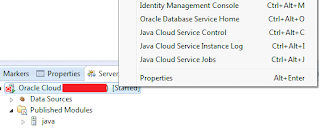
If you specify the correct configuration parameters, you should be able to see your JCS environment under the server's tab as follows:


After the JCS environment is configured, you can publish your applications to JCS, manage them, and monitor statistics.

Oracle is making a lot of investments in cloud research and development.  With WebLogic as the foundation of Java Cloud Service, and the common tooling that supports both on-premise WebLogic as well as JCS, customers can use their preferred IDE (OEPE, JDeveloper, NetBeans) to develop and test locally and deploy to JCS without any code changes - or - use JCS to do all the development and testing, and deploy to production servers on-premise. This brings cost and time efficiencies to development and testing.  There are additional customer benefits, as JCS abstracts the underlying WebLogic and FMW stack taking the ownership and responsibility for installation, configuration, operations, patch management, performance, SLA, ... away from customers.  

For more information about Java Cloud Service, visit Java Cloud Service documentation.

Wednesday, December 29, 2010

A quick & dirty look at web traffic trends on AWS, Azure, Force.com, GAE, and IBM Dev/Test cloud

Since the introduction of EC2 in 2005/2006, a lot has happened.  New service providers such as Google App Engine (GAE) and Force.com have emerged.  Existing hosting providers such as GoGrid & RackSpace have transformed to cloudify their service delivery model.  And, existing platform vendors such as IBM and Microsoft have raced to implement or acquire solutions to respond to this fundamental shift. 

Different types of vendors are competing for market positions.  Some are new: AbiquoNimbula, Cloud.com (formerly VMOps)…  And, some are mature: VMware, Novell/Attachmate, CA, BMC, DELL, …  [The vendor landscape is big and complex, and includes other types of vendors including systems integrators…]

As we close 2010, I thought it would be interesting to look at some usage trends of the big names in the Cloud market. 

The statistics come from Alexa.  It uses its own methods for capturing HTTP traffic, and normalizing the data.  As such, it is important to note that it does not include non-web app workload deployed on these cloud services.  In addition, it is common for enterprises to use DNS aliasing (CNAME) to map to a custom URL.  So, it is important to consider traffic to custom URLs would not be included in the following presentation.
The intent is to provide some ideas about usage and future trends, as these vendors battle it out for dominance and market share.

Please send me any comments or questions at babakh@yahoo.com.

Wish everyone a Happy New Year!

Monday, June 14, 2010

A review and analysis of IBM Test & Development Cloud, and opportunities

IBM finally GA'd its Development & Test Cloud last week: http://www.ibm.com/cloud/enterprise
In addition to a public cloud service offering, IBM is also providing an option to deploy such an infrastructure-as-a-service model on-premise (private cloud): http://www-935.ibm.com/services/us/index.wss/offering/midware/a1030965

I believe Cloud Computing is critical to IBM’s future growth.  It may even be the only solution to declining revenues in some of IBM’s business segments.    I will share some opinions below after a quick solution review.

The IBM cloud is built on Rational & Tivoli components.  Rational provides design, development, testing, and application lifecycle management & governance, and Tivoli enables automated resource provisioning & service management (self-service request management, performance monitoring, usage metering, billing):

I think there is an opportunity for IBM’s Cloud to be a huge success for the following reasons:

Virtualization
For IBM public cloud, KVM powers the virtualization layer.  The on-premise solution is virtualization technology agnostic: KVM, PowerVM, and VMWare.
  • In a previous post, I made the observation that most large enterprises cannot standardize on a single virtualization infrastructure.  They have to deal with multiple virtualization technologies.   While there seems to be some gaps in IBM’s on-premise solution (ex. no Xen or Hyper-V support), I think IBM is in a much better position than VMWare or Oracle to unify management across different virtualization technologies.   This would be a a big competitive differentiator and value to the enterprise.
  • Secondly, in the world of Cloud Computing, vendors are primarily focused on x-86 platform.  All other platforms are ignored.  If IBM can extend their public cloud to support pSeries and maybe even zSeries (mainframe-as-a-service ?), this would also be a huge competitive differentiator.  This would allow more workloads to be moved to the Cloud and benefit customers.  As an example, customers would be able to move some of their mainframe batch jobs to the Cloud to save MIPS.


OS Coverage
The initial set of OS images are limited. In the initial public offering, IBM only offers Red Hat & Novell images.  There are no Windows images (yet ?).  I think it is just a matter of time for IBM to offer Windows images on their public cloud.

As I said above, the on-premise solution can support AIX images now, and maybe zOS in the near future (why not?).  If IBM were to offer AIX & zOS VMs in the Cloud, it would not only be able to realize a new revenue stream and possibly revive that segment, but keep customers from migrating to other platforms.  I think this could open new opportunities.  The challenge is how to do this in a balanced way without cannibalizing the existing customer base, and creating incentives for IBM sales teams to execute after those opportunities.

Pricing
IBM’s cloud “infrastructure pricing” is competitive to AWS.  However, for IBM software, there are different licensing & subscription options:


Customer scenarios Software Infrastructure
Charge Charge
You "bring your own IBM license" ("BYOL") Prepaid for software license Per VM per hour
You own an IBM software license and can use the pre-built IBM images in the portal catalog
You "pay-as-you-go" ("PAYG") Per Image per hour Per VM per hour
You choose the desired software, accept the license terms online, and receive a monthly usage bill
You "bring your own software and licenses" Prepaid for software licenses Per VM per hour
You bring your own software or software for which you hold valid licenses and install them on the servers you provision
You want to test "pre-release" software No charge for restricted use Per VM per hr
From time to time, pre-released software images will be made available on a temporary basis for test (non-productive) use
You are an eligible ISV/SI developer No charge or by usage Per VM per hr
You can use selected IBM "development use only" ("DUO") software for development, test, proof of concept and sales demos on the IBM Cloud
Options available vary by software package.
IBM hasn’t published detailed pricing on their software subscription pricing (PAYG), but it would be a fair to assume it will be less than what they charge on Amazon.  [N.B. on AWS, IBM only offers a very small subset of its software primarily targeting ISVs for development & testing as opposed to enterprise customers.]
Now, let’s talk about the market and the opportunity for IBM.

Market maturity, opportunity & customer addressability
Since the recession a couple of years ago, Cloud Computing has gained more momentum in the enterprise.  IDC estimates spending on Cloud services in the range of $42B by 2012. 
If you look at early Cloud providers such as Amazon or Google, while I have enormous respect and appreciation for the innovation and technical design and delivery of the services, I argue they haven’t been able to gain traction in the enterprise space.  The only exception is SalesForce.com [take a look towards the bottom of this post.].  They have done well, because the founder had an enterprise software background.

As an example, if you look at Google’s enterprise business in 2009, it booked around $209M (that includes revenue from their search appliance + Google Apps).  In a previous post, I estimated AWS revenue to be around $200M / year.    If you compare these numbers with IBM SWG, MSFT or Oracle software revenues, I think it would be easy to conclude they haven’t captured a big marketshare in the enterprise space.  I think this is fundamentally due to their lack of business relationship, partnerships, and investments in sales & marketing.

So, I think this is a good time for IBM to enter the market.

In terms of opportunity and access to market, IBM is a global company with delivery centers around the world. It has business segments that align well with customers considering or transitioning to Cloud Computing. To understand the potential opportunity for IBM better, let's look at some numbers. 

IBM Development & Test Cloud is an offering from Global Technology Services (GTS):
image
The numbers above are in millions.  In 2009, GTS revenue was around $37B with a gross margin of around 35%.

There are several business lines in GTS:
  • Strategic Outsourcing (SO) – This segment offers outsourcing services to commercial and public sector.  In 2009, IBM’s SO revenue was $19.3B.
  • Integrated Technology Services (ITS) – This segment offers different IT services (project based) from IT strategy –> middleware services –> infrastructure services.  In 2009, ITS’ revenue was $8.7B.
  • Business Transformation Outsourcing (BTO) – This segment focuses primarily on business process outsourcing (BPO), and “IT transformation” services.  In 2009, BTO’s revenue was $2.2B.
  • Maintenance – This segment offers product maintenance and support services.  In 2009, GTS maintenance revenue contribution was almost $7B.

IBM has C-level relationships in Fortune companies in all industries.   Some of these companies have already entrusted IBM with their IT infrastructure and mission critical systems.  This puts IBM in a huge advantage over other service providers. 

As SO contracts are renewed, and as ITS engages customers in IT strategy and middleware services, IBM should also be able to harvest opportunities for both private cloud as well as public cloud. 

[N.B.  The cool thing about Cloud services is that they are not like SO contracts (i.e. fixed).  Once you sign up a customer, as long as you’re meeting your SLAs, and manage the offering in terms of features/capabilities, you should be able to maintain a profitable recurring revenue stream (i.e. reduced sales & marketing costs, reduced infrastructure costs through efficient multi-tenant delivery).]

Consider this....If IBM were to convert 10% of 2009 GTS revenue from existing base to Cloud, let's say over the next 3 years, they would make about $3B in Cloud revenue by 2013…Now, that’s revenue & marketshare.

Here is another reason why Cloud could help IBM.    IBM Software Group booked $22B of revenue in 2009:
image
SWG revenue breaks down as follows:
  • Cross-brand middleware:  This is combined revenue from WebSphere, Tivoli, Lotus, Rational, Information Management worth over $12B.  IBM doesn’t break down the revenue by brand. 
  • Other middleware: This include legacy middleware such as CICS & IMS.  IBM made over $4.6B there.
  • Operating Systems: This includes software such as zOS, AIX, AS/400, & TPF.  In 2009, the OS revenue was > $2.1B.  This is dependent on how IBM’s hardware group (Systems & Technology Group) performs.
  • Product Lifecycle Management (PLM): I think it is a joint venture with Dassault Systems.
  • Other: This includes all IBM Software Group services (aka Lab services).  In 2009, the revenue for this part was $1.4B.
As you can see above, except for lab services, x-brand middleware is the only segment that’s been reporting growth. There are two reasons for this:
  • Acquisitions: IBM has made some big acquisitions in this space: (i.e. Cognos for $5B, FileNet for $1.7B, Sterling Commerce for $1.2B…).  Acquisitions help IBM book new business.
  • Renewal rates: This is recurring revenue from existing customers.  I was told by a software sales exec, average renewal rates for a successful enterprise software company is around 98% (depending on the product, maturity, etc).   So, this is helping IBM SWG maintain revenue and marketshare.
I haven’t heard of any new notable products out of SWG lately.  So, looking at the above, I think it is fair to conclude acquisitions have been the primary vehicle for growth in SWG.  So, with Cloud Computing, SWG  should be able to develop a new revenue stream.

So, for SWG, I think Cloud Computing can offer the following benefits:
  • Use Cloud as a sales & delivery channel for SMB.  This would be very helpful to IBM.
  • Offer a viable alternative to clients looking at other sourcing options
  • In the beginning, I think Cloud can offer a parallel revenue stream for SWG particularly for WebSphere, Tivoli, and Rational
  • Compete with other private cloud vendors and public cloud service providers
  • Partners and alliances help IBM realize almost a third of its total revenue.  SWG gains a lot from these GSIs and ISVs.  SWG can offer new solutions to these partners to help grow its revenue.  Also, help ISVs cloudify their solutions.
All of the above should help IBM sustain growth.

[N.B. There is some difference between private and public clouds in terms of revenue.
Software is a high margin business.  In the case of IBM SWG, the gross margin for SWG was 86%.  The reason for this is software licensing & maintenance costs.  With public clouds, this is radically different. It is a volume business.  For IBM to be profitable in the public cloud space, they must sign up more and more customers.  On the private cloud side, they should be able to do better.]
----------------------
IBM is building a good story here.  From SWG side, with WebSphere CloudBurst, the recent acquisition of Cast Iron, and Rational Software Delivery Services, IBM is putting together all the asset to enable Cloud Computing for the enterprise.  On the GTS side, IBM is in a good position to create opportunities, and work with enterprise customers to help transition to Cloud.

Finally, from a competitive perspective, in the enterprise space (as opposed to consumer space), I don’t think IBM needs to worry too much about AWS or Google.  As long as IBM prices its public cloud offerings from GTS, Lotus, etc competitively, and maintain a close relationship with enterprise accounts, I think they should be able to do OK.

In the enterprise space, I think SWG should keep an eye on Oracle and VMWare on one side, and MSFT on the other.  GTS will have to worry about the usual competitors such as CSC, HP/EDS, etc...

Tuesday, April 13, 2010

vmforce: Is Salesforce getting into IaaS?

VMware and SalesForce.com have scheduled a joint webcast on April 27th. Rumors are circulating that Salesforce is planning to offer IaaS based on VMware virtualization platform. 
If true, this would be a good move for Salesforce for the following reasons:
  • Currently with Force.com, you can build and deploy only a limited set of applications (i.e. CRM centric, business process-based/case-management types of apps).   With IaaS, it will possible to deploy all sorts of applications on their platform. 
  • Building on top of VMware virtualization stack (i.e. vSphere), Salesforce should be able to facilitate integration and management of hybrid computing environments for those enterprises that have already invested in VMware.   This would be a huge advantage over competitors such as Amazon & Azure.
  • Azure already offers hosting (Windows).  In some cases, an IaaS from Salesforce may be viable alternative to MSFT.
  • Obviously, an IaaS Cloud Service offering enables Salesforce to engage enterprise customers on multiple levels thereby increasing marketshare.
So, what about VMware?   How would this help them?
VMware wants to be the technology backbone for all IaaS providers.  This is evident in their vCloud initiatives, and investments in vCloud Express and Terremark.   Salesforce.com is a key player in Cloud computing.  Enabling Salesforce deliver an IaaS on top of their virtualization stack is a major deal for them.  If the model proves successful, it can become a big headache for Amazon, Azure, and GAE
VMware also sees itself as a platform for hybrid Cloud Computing:
At this point, this is all speculation.  We should find out more on April 27th. 
What are your thoughts about vmforce?  Do you think VMware would be able to strike a similar deal with Google, eBay or Yahoo to offer an IaaS?

Tuesday, March 09, 2010

Technology-centric approach to Enterprise Cloud Computing doesn’t work

There is a lot of Internet chatter and conversation on Cloud Computing.  Since 2007, Google Trends shows growing increase in Cloud search keywords:

image

Majority of these articles and posts though are primarily focused on technologies (i.e. virtualization, dynamic provisioning, security, management & automation, metering & chargeback) that enable building a Cloud infrastructure or platform.  Technology decisions and effective implementation are absolutely necessary, but building, operating, offering, and managing a Cloud transcend technology. 

Cloud Computing doesn’t arrive in a box of CDs.  It is an evolution in IT competency and operational model (i.e. Incident Management, Asset Management, Configuration Management, Change Management, Performance & Capacity Management, SLA Management).  A technology-centric approach to Cloud Computing does not address IT operational gaps.

One of the fundamental requirements for Cloud transition is IT standardization.  Standardization is key to IT simplification and cost reduction, and requires an analysis of both IT and application portfolio.  In this regard, an analysis of the various workloads, performance characteristics, HW/SW compatibility & infrastructure requirements, application strategy such as any decommissioning, re-hosting, or outsourcing plans,… and review of enterprise architecture are necessary to establish standard configuration templates.  Without such an analysis, it would be very difficult to determine the right set of services to offer in the enterprise.  A technology-centric approach to Cloud Computing does not address IT standardization.

As I said in a previous post, there are different entry-points to Cloud Computing.   There are a couple of implications here.  First, organizations choose different strategies and approaches for IT cloudification based on their priorities.   Second, organizations are at different levels of IT maturity.  Some may have experience building and running CoEs. Some may have experience operating & managing shared services centers. Finally, some may already be running a Cloud (or have already implemented an on-demand and utility-based shared infrastructure way before the term “Cloud” was in vogue.) So, there is a lot of considerations in terms of organizational maturity, alignment, change management that are essential to a successful Cloud transition. These are not addressed by a technology-focused approach to Cloud Computing.

These were just some examples.  So, next time when you get a visit from a vendor, showing you a quick demo of 1000-node cluster, with dynamic scaling may be including spillover to EC2, a nice management interface, etc, a question to consider is how do I operationalize this? 

Tuesday, November 10, 2009

Workload Analysis in Cloud Computing

Not all workloads are the same, and not all Clouds are the same!

Different applications have different set of requirements and characteristics.  Some Clouds (i.e. GAE or Heroku) are natural fits for certain class of workloads (i.e. WebApps) whereas for other types of workloads (i.e. batch), other Cloud services (i.e. AWS) are more appropriate.  In some cases, the business operation and/or legal requirements may require a completely different deployment (i.e. private Cloud). In a previous post, I referred to workload analysis in the context of approach to Cloud adoption. In this post, I thought to share some ideas about it.

The aim of Workload Analysis in Cloud Computing is to look at different aspects or characteristics of an enterprise application to determine the feasibility of moving or porting the application to the Cloud.  This analysis also provides input to implementation approach, Cloud service selection, and an initial business value assessment (i.e. cost reduction, IT simplification)…

The following proposes some guidelines in workload classification & characterization:

Workload Category: At a high-level, there are two kinds of applications in the enterprise:

  1. Custom Applications – This class of applications are developed and maintained by the enterprise.  The enterprise has control over its design, technology selection, implementation,  infrastructure requirements, maintenance, and overall portfolio roadmap. 
  2. Packaged AppsFor this class of application, the respective vendor is in control of its implementation, packaging, release, supported configurations, product plans, etc.

In the case of Custom Apps, If an enterprise is considering to deploy an application to the Cloud to achieve cost reduction or simplifying IT by delegating the infrastructure operation/maintenance to an IaaS, there is flexibility from simply taking the application pretty much as is to the Cloud –> re-factoring the application to leverage Cloud services (i.e. RDS).  In the former, the potential is substantial savings in infrastructure cost and business value in terms of new hardware & software purchase avoidance –> potential for much better SLAs and a lot more cost savings by reducing or totally eliminating the burden of additional FTEs (i.e. Database Administrators).

For Packaged Apps, the enterprise may or may not be able to move the solution to the Cloud due to licensing restrictions, technical infrastructure requirements, complex integration issues with other back-ends, etc… [it is good to check the packaged vendor for any existing or future plans for SaaS offering…]

Next, there are a set of general characteristics or attributes to consider when analyzing the applications:

  • Workload Type: In general, there are two types of workloads: Batch or Online.  It is important to consider this differentiation for the following reasons:
    • There are different resource requirements and considerations. As an example, batch workloads may require specific capacity in terms of storage and compute resources (i.e. vCPU, memory) to finish the job in a timely fashion whereas for online workloads network bandwidth may be more critical…
    • There are differences in programming models.  As an example, some batch jobs may be implemented over a framework like Hadoop whereas for some online workloads a PaaS like Force.com may be the best choice. 
  • Workload Frequency:  Sometimes, a workload may run at month-end or every quarter.  I like to note this attribute in the analysis for investment cost / benefit analysis.
  • Workload Cost: It is important to capture the total cost of workload including hardware, software, application maintenance and support, etc.  I think it would be even more useful to develop a cost allocation model reflecting percentages in infrastructure, software, application development, support and maintenance, etc…  This information is useful in Cloud service selection.
  • etc…

So, in summary, it is good practice to develop a consistent approach/process for analyzing workloads in Cloud Computing adoption.  This analysis has a range of use from business case justification to Cloud service selection. 

Also, as described in previous post, there are several sources of information to aid in workload analysis (i.e. Project Portfolio Repository, any existing server/application consolidation or decommissioning analyses, issues log or problem management database, etc). 

Finally, I highly recommend an excellent presentation that David Chou posted on his blog on patterns of moving to the Cloud

Wednesday, November 04, 2009

The future of SOA is Cloudy…

A couple of months ago, I was at an Oracle event in Redwood Shores.  The event brought together some of Oracle’s marquee customers & Fusion middleware product management team to discuss challenges/issues with regards to SOA, BPM, infrastructure management... and provide an opportunity to learn more details about FMW roadmap and offer feedback…

I seized the opportunity to talk to several customers about their SOA implementation.  Most of the customers (small –> large) had passed the initial stage of SOA readiness assessment, transition planning, and initial service portfolio development.  They had already implemented and deployed multiple enterprise services into production.  The most common issue related to SOA infrastructure management, and making sure it offers the level of resiliency and availability their customers demanded.

SOA introduces additional layers in the already multi-tier distributed applications.  First, you have the SOA management layer that handles performance management and policy enforcement.  Next, you have the Enterprise Service Bus (ESB) that abstracts service endpoints, and offers integration logic intermediation between service consumers and providers.  Finally, there may be integration adapters used to facilitate semantic and protocol integration with backend applications (i.e. SAP).  During a service request, all of these components must be available and fully functional.  Otherwise, the request fails and either the infrastructure must handle automatic management of the exception and re-routing of the service request message to maintain SLAs or the client must re-try the request upon receiving the exception.

Another area of concern is related to capacity management.  It is common practice to use high volume / peak load metrics to calculate capacity.  The result is over-provisioning of resources  (AKA server proliferation) and low utilization of assets.  In terms of IT financial management, the impact is monumental from increased hardware and software licensing costs to additional FTEs to configure & maintain the assets, and finally data center floor space, power consumption, …

So, many customers are already in their next level of SOA maturity.  They are focused more sharply on SOA operational governance.  This is where “Cloud” and SOA converge.

Before we get to that, let’s do a quick review of “SOA business value”.

SOA promises lower IT costs, reduction of IT complexity, business agility, etc… However, rarely is SOA business value measured against metrics related to the above.  The universal measurement for SOA in many organizations continues to be “service reuse”.  The more reuse, the better…Often, it is not even clear at what level of the organization reuse occurs to map and measure the value more clearly, but that’s a whole different blog…

For SOA to deliver lower IT costs, reduction of IT complexity, and agility, it is required to change the infrastructure to be more adaptive and resilient.  Unfortunately, in my experience, this is often not properly considered in SOA programs.  The vendors give you an ESB, and you’re good to run :-[

The “cloudification of SOA” involves the following capabilities:

  • Dynamic Resource Management – Rather than over-provisioning to meet peak demand, a private Cloud infrastructure can enable demand-based provisioning.  This enables the enterprise to utilize IT assets more effectively and realize reduction of IT costs in terms of HW/SW/datacenter.  For some workloads, policies can be established to spill over to public Clouds like Amazon (hybrid Cloud). 
  • Automation – Automation is a key component of Cloud infrastructure.  Automation is used in a variety of scenarios from automatic scaling to align with resource demands as well as automatic error/exception recovery.  This is a key enabler for service level management.
  • Performance Management – Performance visibility and management across different layers of the stack is fundamental to any Cloud infrastructure.  Without it, there is no DRM or automation.  Once the organization is able to capture and correlate performance metrics across different layers and map them to a service request, they can do a better job of capacity management.  This also helps SOA with service performance management and SLA.
  • Self-Service capabilities – Finally, this is an area that may not be readily consumable in all organizations, but it is a vision.  The idea is simple.  The goal is to bring the same self-service capabilities available in public Clouds to the enterprise (i.e. self-service service registration, self-service provisioning, self-service resource configuration and policy specification, etc…)   Imagine an environment where you can go to a self-service portal and request a server from a list of pre-configured images, click a button to provision a server in a few minutes rather than a few weeks that typically takes for IT request review/approval, procurement, HW installation and configuration, and delivery… Many companies are looking at this approach or have already implemented initial self-service portals to enable self-service capabilities.  In this scenario, it is possible to communicate IT agility using concrete metrics (i.e. average time to provision a server, # of demands serviced / week, etc)

Here is a conceptual diagram to illustrate the above:

image

So, to summarize, SOA operational governance and management poses difficult challenges in the enterprise.  The common approach to SOA does not address infrastructure issues to enable realization of SOA business values.  A Cloud Computing approach can help organizations with that.

I would be very curious how many are looking at Cloud as a progression of their SOA programs, and if they are looking at self-service capabilities.  Look forward to comments or questions.

Monday, October 19, 2009

IBM Cloud for Development & Test

IBM has a new service IBM Smart Business - Cloud for Development and Test that offers developers a set of pre-configured images for implementation and lifecycle management of IT solutions based on IBM stack.  It looks like it went beta September 30, 2009.

This service was mentioned in an IBM press release in June, but I don’t think it got picked up by any Cloud Computing forums/SIGs.  IBM itself didn’t promote it much either.  In this initial release, it is free and offers a limited set of images from IBM Rational and WebSphere portfolio.  It provides a nice self-provisioning control panel to manage servers:

image

Personally, I have been waiting for such a service from IBM for a long time, because it has been a pain uploading IBM software to build environments on other public clouds (especially those that require multiple server components). 

I think IBM could/should have done this 4 years ago (when I was at IBM, I talked to several executives about it).  Never-the-less, I think it will be a successful offering and IBM should see rapid adoption.  I also believe that it enables an infrastructure to support complex hybrid cloud usecases especially for those set of customers that have invested in IBM infrastructure and middleware technologies.   Finally, as the service matures (i.e. additional platform services and APIs), it shouldn’t be limited to just developers building apps.  Customers should be able to host enterprise apps or build new apps using their cloud services…

Saturday, September 12, 2009

Oracle, Sun’s assets, Gridification of FMW, and Cloud Computing

Oracle’s acquisition of Sun hit a snag in EU earlier this month. According to their statement, the EC is concerned that Oracle (the largest database vendor) + Sun’s MySQL (the largest open-source db) would be an anti-competitive combination in their market.  So, they are going to look at this further and make a ruling by Jan 2010.

This is unfortunate for Sun’s customers and also business partners, since it delays any communication from Oracle on product support, strategy, plans, roadmap, etc.  Customers must wait to get more details on how this acquisition may effect their investments in Sun technologies.   For Sun’s business partners, deals are probably on hold until Oracle is legally able to unveil more information. 

There are a lot of rumors around this acquisition.  This reminds of when Oracle acquired BEA.  Back then, I remember hearing some wild speculations about what Oracle might do with BEA assets.  Fast-forward to Fusion Middleware (FMW)11g, JRocket & WebLogic  (along with Coherence) are now key components of FMW, more specifically, Application Grid, and majority of the BEA assets are incorporated into other layers of FMW (i.e. SOA, BPM).  

So, in terms of Sun acquisition, we are just going to have to wait until EC’s ruling to get more details from Oracle :-[   Now, since my interest is in Cloud Computing, I thought it would be interesting to speculate what Oracle may do with Sun technologies once they close the deal…  Before we being to discuss Sun’s Cloud Computing related assets, let’s take a look where these companies are vis-a-vis Cloud Computing.

Sun has long had a vision for network-based computing dating back to a couple of decades ago.  However, their most recent efforts have involved Network.com where they offered a public Grid over the Internet, followed by Caroline which delivers a Platform-as-a-Service based on OpenSolaris, Sun’s virtualization technologies, and HPC solutions.   At this point, some of Sun’s partners (i.e. webappVM, Vertica) have deployed on Caroline.

As for Oracle, there hasn’t been any major announcements around their own Cloud platform.  So far, their efforts have involved offering a set of AMIs on Amazon + Cloud DB backup, and data encryption (which is really a function of Oracle database itself).  

Here is a high-level overview of related assets:


Sun

Oracle

Compute Hardware Sun offers a range of servers powered by its own chip technologies as well as commodity x86/x64 processors.  These solutions have been used at large scale internet service providers such as STRATO None
Compute Storage Sun offers a range of high performance and scalable storage solutions None
Compute Network Sun offers a range of networking solutions from Ethernet-based solutions, to FC SAN adapters & switches, and high performance computing/low latency solutions (Infiniband) None
Operating Systems

Solaris – Sun’s legacy operating system.  The last version of this product is Solaris 10 (2005).

OpenSolaris – This is the open-source version of Solaris and Sun’s strategic OS.   It is a core technology in Sun Open Cloud.

Oracle offers its own distro of Linux based on Red Hat
Server Virtualization

OS-Level virtualization - Sun has integrated Xen into OpenSolaris operating system and offers different levels of resource virtualization (i.e. Zones, Containers, DSC, Crossbow…)

Logical Domains (LDoms) – Sun hardware based virtualization solution

Oracle VM
Storage Virtualization Sun offers a range of storage virtualization solutions None
Desktop Virtualization

Virtual Desktop Infrastructure (VDI)

Sun Virtual Box

None
Virtualization Management xVM Ops Center

OpenSolaris offers built-in resource management facilities for virtual & physical environments
Oracle VM + Virtual Iron
Oracle VM Manager

Oracle Enterprise Manager
High  Performance Computing (HPC) Sun offers a complete stack for HPC workloads (i.e. Sun Constellation System) Oracle Database Real Application Clusters (RAC)

Automatic Storage Management
Application Support GlassFish
MySQL
NetBeans
FMW
Oracle DB
Suites of Eclipse based and non-Eclipse based tools
Systems Management N1 Service Provisioning Service (SPS)

Sun Management Center
Oracle Enterprise Manager

As far as Cloud Computing, here is what I think Oracle will do:

  • Sun hardware – This should be pretty straight forward.  I think Oracle will just continue forward with Sun hardware and existing plans.  From an organizational model, there will probably be a new hardware division including all former Sun server, network, and storage groups.  From a Cloud perspective, Oracle will deliver private Cloud offerings based on Sun hardware and an “Oracle-optimized” software stack.
  • Sun virtualization – Although both Oracle & Sun have implemented their hypervisors based on Xen, Sun has integrated virtualization at the OS level (similar to Red Hat) whereas in Oracle’s case, it is bare-metal hypervisor.  I think the product management team will decide to keep both to offer customers choices, but probably standardize on a single virtual management framework.  In addition, this acquisition will enhance Oracle’s virtualization portfolio with network and storage virtualization solutions as well as desktop virtualization.  I think Oracle will invest in all virtualization technology areas including VDI, as they will be considered growth areas.
  • OpenSolaris – I think Oracle will create an open-source software division to manage OpenSolaris, Sun Cloud, and other software assets & open-source projects.  I also think they will let the developer community to continue to use tools like Netbeans for the foreseeable future.
  • Public Cloud – After this acquisition, Oracle will be able to offer a public Cloud based on OpenSolaris.  Within a short period of time, I expect to see Oracle’s software available on Sun Cloud.  I also expect Oracle to continue to rally the industry around Cloud standardization…
  • Systems Management – At some point, after they figure out how to establish a line between open-source and commercial solutions, Oracle will probably port all of Sun systems management solutions to Oracle Enterprise Manager for unified operation and management.